MAI-Image-2.7 and MAI-Image-2.7 Flash are Microsoft's two models for editing an image by API while changing only what you ask for. On our test of 24 November 2026, a fictitious shop invoice with one quantity and two totals to correct, both returned all three changes exactly: Flash in 9.29 s for 24.975 credits (about KES 1.84), 2.7 in 17.52 s for 84.254 credits (about KES 6.22). That is one run each, so one sample and not a benchmark.
Both are public previews, announced by Microsoft on 17 November 2026. The prices and figures in this article are those of 24 November 2026: read the current price on the MAI-Image-2.7 and MAI-Image-2.7 Flash model pages.
In short
- What they are. Two Microsoft image models that generate from text and edit existing images. Microsoft presents 2.7 as its precision tier and Flash as the lower-latency, lower-cost member at comparable quality.
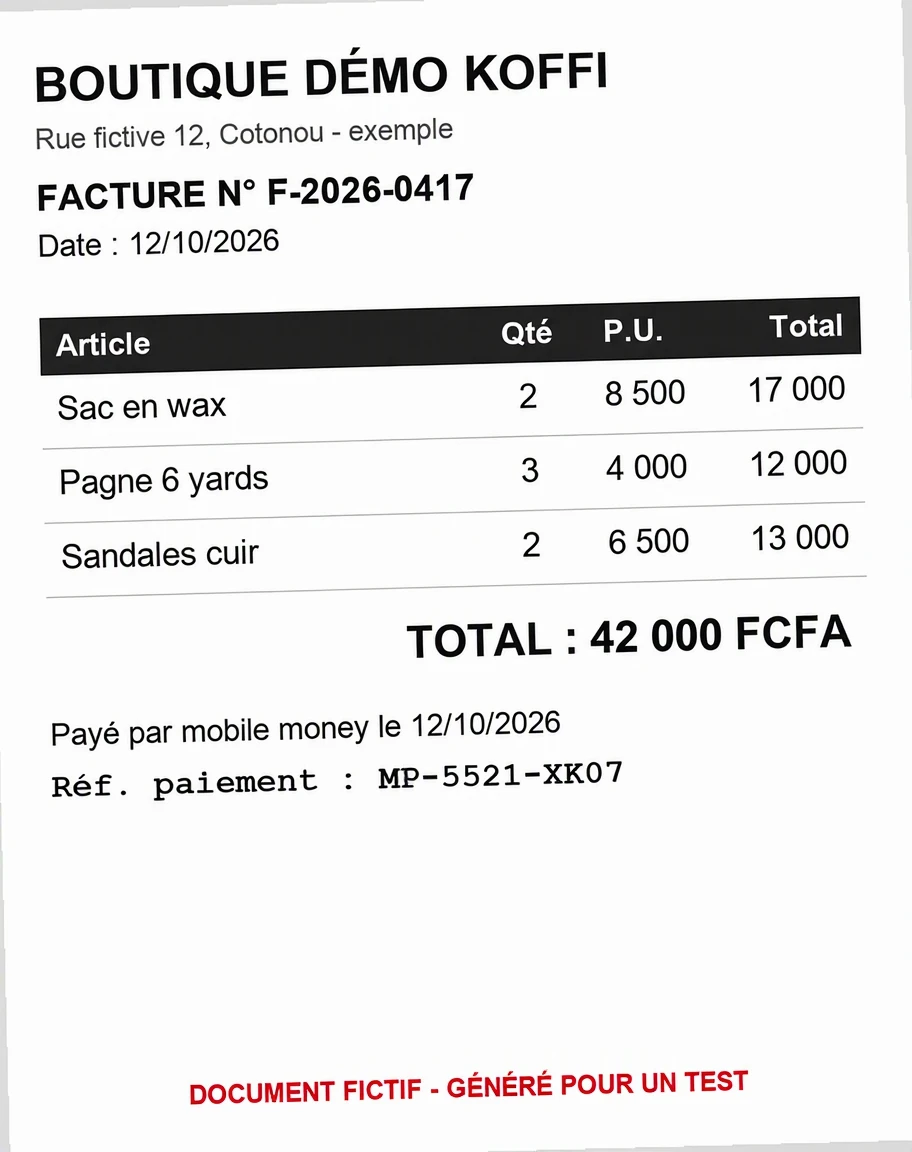
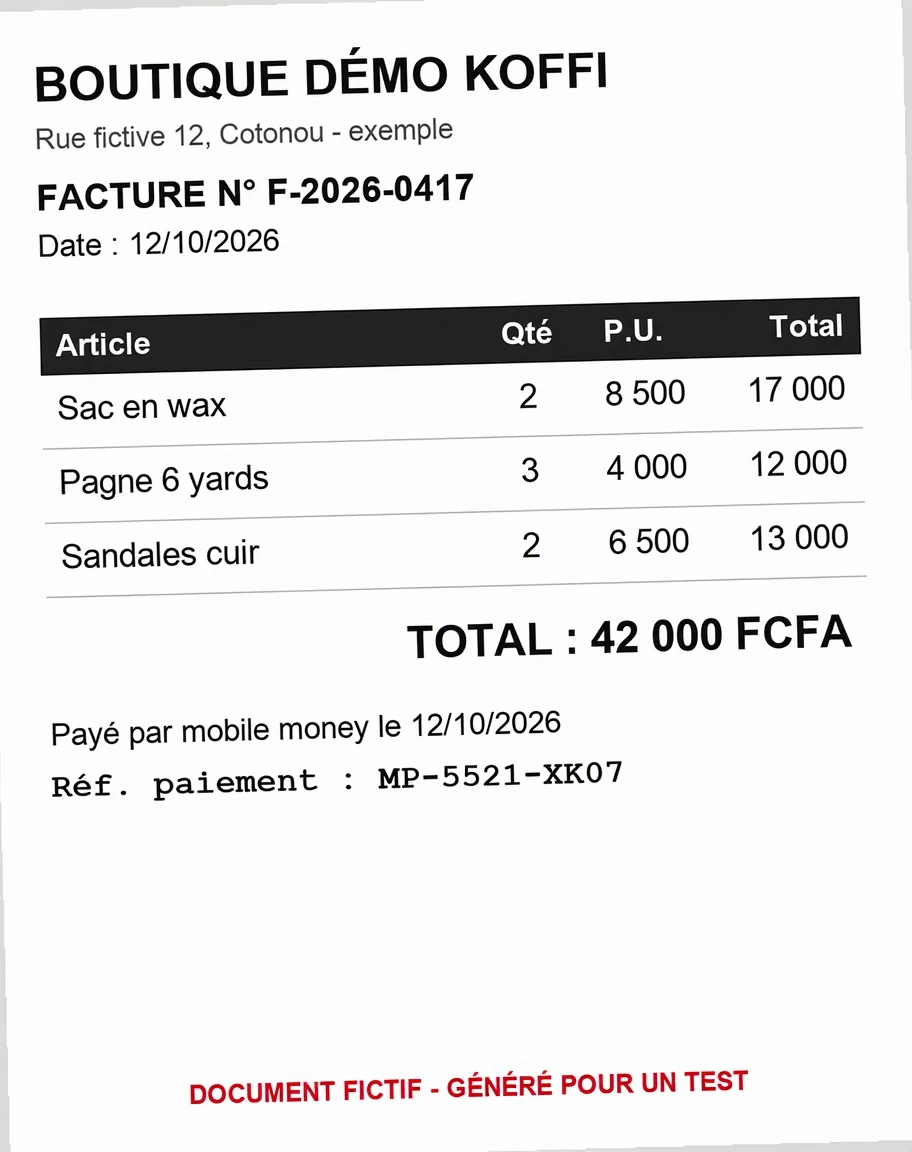
- Our test. A fictitious 720×900 invoice, one prompt in French: quantity from 1 to 2, line total from 6,500 to 13,000, grand total from 35,500 to 42,000 (the invoice itself prints them with French spacing, as 6 500, and in F CFA, the currency of the fictitious shop; these are not Tchavi prices). All three values came out exact on both models, with the rest of the text intact, accents included.
- Speed. 17.52 s for 2.7, 9.29 s for Flash: about 1.9 times as fast.
- Price on Tchavi. 84.254 credits per image for 2.7, 24.975 for Flash, about KES 6.22 and KES 1.84. Each reference image is billed on top, by its size. The invoice edit, reference included: about KES 7.13 with 2.7, about KES 2.14 with Flash.
- Limits. Preview, one image per request, no transparent background on Tchavi, no resolution or quality setting.
What is MAI-Image-2.7, and how is Flash different?
It is the image model from Microsoft AI. According to Microsoft's announcement page, it aims at precise edits to existing images: removing or replacing an object, changing an attribute, updating text, cleaning up a defect, while keeping the original's composition and layout. It also generates an image from text. These are Microsoft's claims: our test, below, checks only part of them.
Flash is the lower-latency, lower-cost version. Microsoft says its quality is comparable to the precision tier. On Tchavi both take the same settings: a prompt, up to five reference images (JPEG or PNG), seven aspect ratios (1:1, 4:3, 3:4, 16:9, 9:16, 3:2, 2:3) or auto to follow the reference.
How precise is it on an invoice?
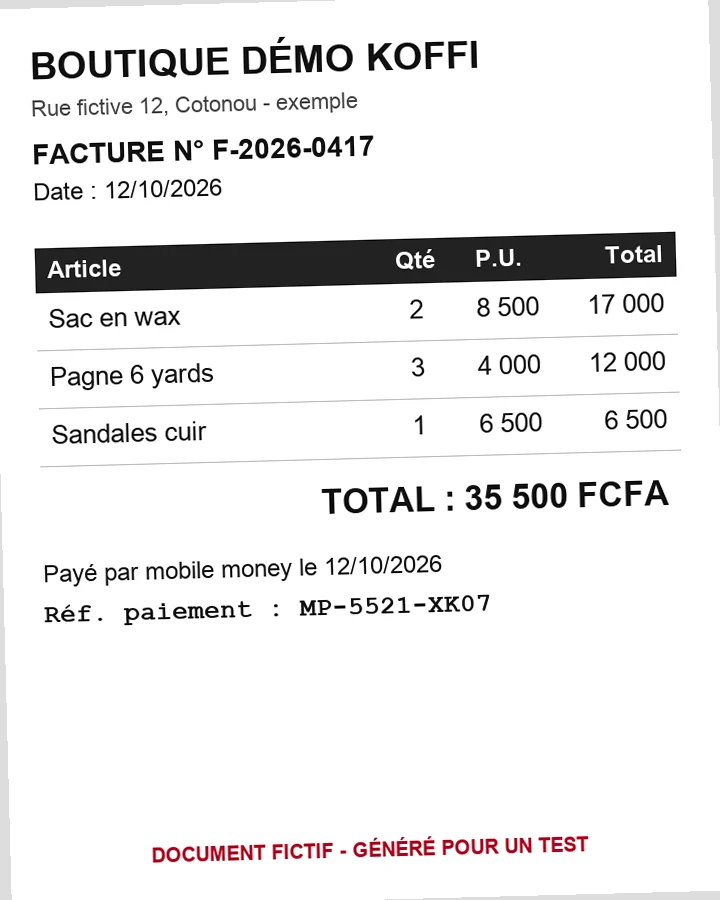
The test: a fictitious invoice from "BOUTIQUE DÉMO KOFFI", in Cotonou, with no person on it. Three lines, a total, a payment reference and a "DOCUMENT FICTIF" notice. The prompt, in French, has the shop correct its own invoice: on the "Sandales cuir" line, the quantity goes from 1 to 2 and the line total from 6,500 to 13,000 (the unit price stays 6,500), and the grand total goes from 35,500 to 42,000. It asks to keep the same font, size and alignment, and to change nothing else. It is 641 characters long.
We sent that prompt and the image to each model, once each, on 24 November 2026, directly to the models' host and not through Tchavi's API: the times are not the ones you will see through Tchavi, and the prices are Tchavi's rate card, not actual charges. The original image: input. The results: 2.7 output and Flash output.
| Measured on 24 November 2026, one run each | MAI-Image-2.7 | MAI-Image-2.7 Flash |
|---|---|---|
| All three values changed, exact | yes | yes |
| Unit price 6 500 kept | yes | yes |
| Other text intact, accents included | yes | yes |
| Time, from sending to receiving the image | 17.52 s | 9.29 s |
| Output size | 912×1152 | 912×1152 |
| Output image tokens | 1,026 | 1,026 |
| Pixels unchanged outside the edited areas | 92.01% | 92.22% |
How to read this table:
- The text was checked by eye:
2,13 000, the new grand total, thenDÉMO,Réf.andGÉNÉRÉfor the accents. No error. That is one invoice, in French, once: it is not a guarantee for your documents. - The unchanged-pixel share is measured like this: we scale the output from 912×1152 down to 720×900 (LANCZOS resampling), then count the pixels outside the two edited areas (the quantity and total cells of the "Sandales cuir" line, and the grand total line) whose every colour channel differs from the input by 8/255 or less. The resize itself makes some pixels differ, and we did not isolate that part: some of the remaining 8% comes from the measurement, not from the models.
- The gap between 92.01% and 92.22% means nothing on one run each. Take away that both left the rest of the image roughly in place, not that Flash is more faithful.
- The size: the output is larger than the input (912×1152 for 720×900, same 4:5 ratio). There is no resolution setting: you choose the shape, the model chooses the size.
How fast do they edit?
Flash returned the image in 9.29 s, 2.7 in 17.52 s: Flash was about 1.9 times as fast. That is the total time measured from sending to receiving the image, for a single request each. Another day or another image would give other times, and nothing says the gap stays the same. Measure on your own images before sizing anything.
What does an edit cost?
Prices read on Tchavi on 24 November 2026. KES figures use the rate read on 2026-11-10 (1 credit ≈ KES 0.07385), two weeks before this article, and it moves with the market:
| What you pay | MAI-Image-2.7 | MAI-Image-2.7 Flash |
|---|---|---|
| One image, no reference | 84.254 credits, ≈ KES 6.22 | 24.975 credits, ≈ KES 1.84 |
| One 720×900 reference (on top) | ≈ 12 credits, ≈ KES 0.91 | ≈ 4 credits, ≈ KES 0.30 |
| One 1024×1024 reference (on top) | ≈ 19 credits, ≈ KES 1.40 | ≈ 6 credits, ≈ KES 0.44 |
| One 2048×2048 reference (on top) | ≈ 76 credits, ≈ KES 5.61 | ≈ 24 credits, ≈ KES 1.77 |
| Prompt past 800 characters, per extra 1,000 | ≈ 5.8 credits, ≈ KES 0.43 | ≈ 2 credits, ≈ KES 0.15 |
| The invoice edit (one 720×900 reference) | ≈ 97 credits, ≈ KES 7.13 | ≈ 29 credits, ≈ KES 2.14 |
Three things to know:
- An image costs 24.975 credits with Flash, about 30% of the price of 2.7 (84.254). The price depends neither on the shape you pick nor on a resolution, which does not exist.
- A reference is billed on its size, not at a fixed price: the bigger your photo, the more it costs. Shrink it before sending if fine detail does not matter.
- The first 800 characters of the prompt are included in the price. Past that, the extra text is billed, and a prompt is never refused for that reason. The one in our test (641 characters) was within the limit.
For the invoice edit: 84.254 credits plus about 12 for the reference, so about 97 credits (96.611) with 2.7; 24.975 plus about 4, so about 29 credits with Flash. The exact cost of each call is in the X-Credits-Used response header. The call details are in the image generation documentation, and other prices are on the pricing page.
MAI-Image-2.7 or Flash: which one to pick?
| Your situation | Pick | Why |
|---|---|---|
| First tries, document corrections, volume | Flash | Same result on our test, about 1.9 times as fast, about 30% of the price |
| Iterating quickly on a visual from text | Flash | Time matters on every iteration |
| An edit where Flash gets your images wrong | 2.7, to test | It is Microsoft's precision tier; we have no test where it wins |
| You need a transparent background | neither, on Tchavi | Not available |
| You need to choose the output resolution | neither | No resolution or quality setting |
| An automated flow that must never change | wait, or re-check often | Both are previews |
Our advice: start with Flash on your real images. If an edit does not hold, replay the same one with 2.7 and compare. On our single test, nothing justifies paying about 3.4 times as much, but one test is not a verdict.
What are the limits?
- Preview. Microsoft announced both on 17 November 2026 as public previews, not final releases. Behaviour, availability and price can change: re-check your results before relying on them in a fixed flow.
- One image per request. For several variants, send several requests.
- No transparent background on Tchavi. Microsoft says the models support it, but Tchavi does not pass it through. No resolution or quality setting either: a request that names one is refused before anything is billed.
- Five references at most, in JPEG or PNG.
- One language tested, one invoice. We make no claim about other languages, other fonts or smaller text.
- One sample. One run each: times, measured prices and pixel shares can vary from call to call.
FAQ
MAI-Image-2.7 or Flash: which one for editing an image?
Start with Flash. On our invoice edit of 24 November 2026, both returned all three changes exactly, Flash in 9.29 s against 17.52 s and for about 30% of the price (24.975 against 84.254 credits). Move to 2.7, Microsoft's precision tier, if Flash misses an edit on your own images. One run each: this is not a verdict.
How much does it cost to edit an image by API with MAI-Image-2.7?
On Tchavi, on 24 November 2026: 84.254 credits per image (about KES 6.22) with 2.7 and 24.975 (about KES 1.84) with Flash, plus each reference image billed on its size (about 12 and 4 credits for a 720×900 image). At Tchavi's rates, our invoice edit, reference included, comes to about 97 credits (KES 7.13) with 2.7 and about 29 (KES 2.14) with Flash. KES uses the rate read on 2026-11-10. Read the current price on the model page.
Can I edit an image I already have?
Yes. Send up to five reference images, JPEG or PNG, with a prompt that says what to change and what to keep. With auto, the output follows the proportions of your reference.
Can I choose the resolution or a transparent background?
No, neither. You choose the shape with one of the seven ratios or auto, and the model chooses the size: 912×1152 for a 720×900 reference in our test. There is no transparent background on Tchavi.
Is MAI-Image-2.7 ready for production?
Both are public previews, announced by Microsoft on 17 November 2026. Microsoft can change their behaviour, and the price can move. For an automated flow, check the results regularly.
Does the French text come out without mistakes?
On our test, yes: three values changed exactly and the other texts intact, accents included, checked by eye on one invoice. It is a single image, once per model: run your own test with your documents before trusting it.
Create your account and top up KES 250
Ready to call it? Edit an image by API. Read next: new image models on Tchavi: GPT Image 2.5, FLUX 3, Grok Imagine.
This article is part of the series "Building an AI product from Africa". Tchavi is an OpenAI-compatible AI API gateway: one key gives access to over 100 text, image, audio and video models, and you pay for it with mobile money, no bank card (countries and operators). More guides on the blog. Follow us: LinkedIn and X.