We use cookies to enhance your experience, provide personalised content, and analyse our traffic; see our Cookie Policy.
openai/gpt-image-2.6-flareOpenAI's image model built for fast iteration
GPT Image 2.6 Flare is OpenAI's image generation and editing model released on 4 November 2026, the speed tier of the GPT Image 2.6 line.
OpenAI positions it as optimised for speed: fast iteration, interactive text-to-image and image-to-image workflows, rendering about 50% faster than GPT Image 2.5 according to OpenAI. It is the model for trying twenty variants of a product shot or a character before you commit. On Tchavi: three formats, five quality levels from low to max, and up to 16 reference images to edit a picture or keep a style.
On Tchavi you pay with mobile money, no card and no KYC. One API key opens 100+ models, images and video included: compare GPT Image 2.6 Flare with the others on the same prompt.
OpenAI's own figure versus GPT Image 2.5, for fast iteration
Interactive text-to-image and image-to-image workflows
low and medium to iterate, high to max for the final render
Up to 16 images to edit a picture or keep a style
Generate up to 10 images in a single request
PNG, JPEG, WEBP or GIF, with transparent backgrounds
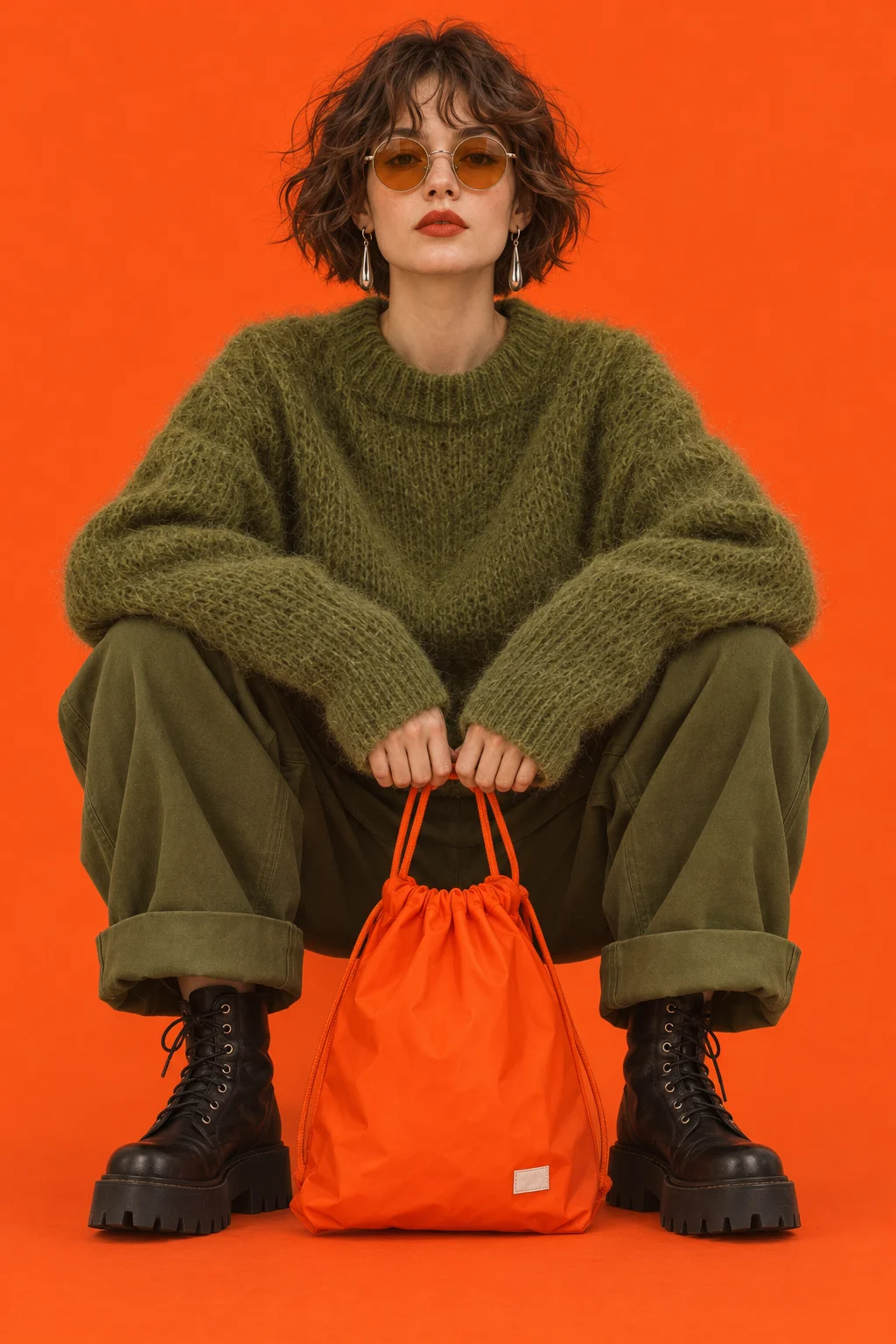
Full-length fashion editorial portrait of a young woman in a deep squat, facing the camera straight on, perfectly centred and symmetrical, her forearms resting on her knees. Seamless saturated vermilion-orange studio backdrop, the exact same orange as the bag she holds. She wears an oversized moss-green mohair sweater with a thick, visibly fuzzy chunky knit and sleeves long enough to reach her knuckles, wide-leg olive-green cotton trousers rolled into heavy cuffs at the ankle, and black chunky lace-up platform boots with deep lug soles. Round amber-tinted sunglasses with thin wire frames, long silver drop earrings, a matte brick-red lip. Short dark brown tousled bob with a wispy fringe, strands catching the light. Between her feet she holds the gathered neck of a bright orange nylon drawstring bag, a small white woven label stitched near its base. Flat, even frontal studio lighting, soft and shadowless on the face, a faint contact shadow under the boots. Crisp commercial lookbook photography, sharp fabric detail, complementary orange and olive palette, no text anywhere in the frame.
Pick Flare when you are iterating fast — trying many variants of a product shot or a character before you commit; OpenAI puts it at about 50% faster than GPT Image 2.5. Pick Sunburst for dense, text-heavy layouts where details must hold up from edit to edit.
Flare is the speed-tier sibling, released 4 November 2026 at the same price as 2.5 Sunburst. Use 2.5 Sunburst only to reproduce an existing look; for new iteration-heavy work, Flare is built for that.
low or medium while you work on the prompt, high for most final renders, xhigh or max when a detail has to be perfect.
Yes: send up to 16 reference images with your prompt. Each one adds 18 credits.
With your Tchavi API key, request an image with model: "gpt-image-2.6-flare", your prompt, the size and the quality.
Yes. Top up your Tchavi account with Orange Money, MTN MoMo, M-Pesa or another mobile money operator. No bank card is needed. Credits land as soon as the payment is confirmed and are deducted as you use them.
Yes. Keep your current OpenAI SDK, just change the base URL to Tchavi's (shown in the API tab) and use your Tchavi key. The rest of your code stays the same.
import Tchavi from '@tchavi/sdk';

const client = new Tchavi({ apiKey: 'API_KEY' });

const result = await client.images.generations.create({
  "model": "gpt-image-2.6-flare",
  "prompt": "A cute cat wearing a space suit",
  "n": 1,
  "quality": "low",
  "size": "1024x1024"
});

console.log(result.data[0].b64_json);
console.log('Credits used:', result.tchavi.credits_used);Every parameter this model accepts on the API. Check the SDK for full typings.
modelRequiredID of the image model (e.g. `gpt-image-2.6-flare`).
promptRequiredText description of the image to generate.
n1Number of images to generate. The maximum depends on the model: up to 10 on GPT Image, 6 on Qwen Image 3, 1 on most others.